
Military time is the 24-hour clock system that eliminates the AM/PM ambiguity of the standard 12-hour format. Instead of cycling through 1–12 twice per day, military time counts continuously from 0000 (midnight) to 2359 (11:59 PM). While Americans call it "military time," most of the world simply calls it "the time" — the 24-hour format is the default in Europe, Asia, South America, and Africa.
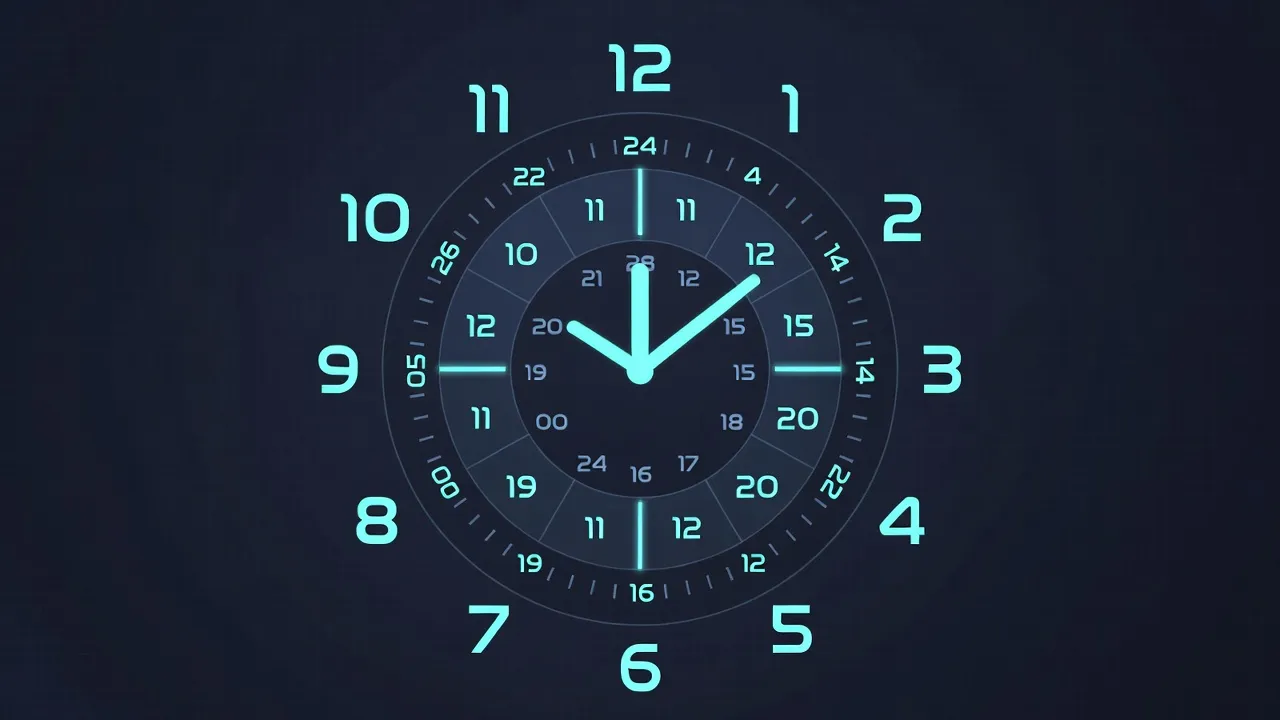
How Military Time Works
The system is straightforward: the first two digits represent the hour (00–23) and the last two digits represent the minutes (00–59). In traditional military communication, there is no colon between hours and minutes, and times are spoken distinctly — "1430" becomes "fourteen thirty." In digital systems and our time zone converter, the colon is typically included for clarity (14:30).
The key advantage of the 24-hour system is zero ambiguity. There is no way to confuse 0800 (8:00 AM) with 2000 (8:00 PM). For shift workers, medical professionals, and anyone coordinating across multiple time zones using tools like our EDT to CST converter or PDT to EDT converter, this clarity prevents costly errors.
Military Time Conversion Chart
| 12-Hour | Military | Spoken |
|---|---|---|
| 12:00 AM (midnight) | 0000 | Zero hundred |
| 1:00 AM | 0100 | Zero one hundred |
| 6:00 AM | 0600 | Zero six hundred |
| 9:00 AM | 0900 | Zero nine hundred |
| 12:00 PM (noon) | 1200 | Twelve hundred |
| 1:00 PM | 1300 | Thirteen hundred |
| 3:30 PM | 1530 | Fifteen thirty |
| 5:00 PM | 1700 | Seventeen hundred |
| 6:00 PM | 1800 | Eighteen hundred |
| 9:00 PM | 2100 | Twenty-one hundred |
| 11:59 PM | 2359 | Twenty-three fifty-nine |
Quick Conversion Rules
- AM hours (1–11): Add a leading zero if needed. 7 AM = 0700, 11 AM = 1100.
- 12 PM (noon): Stays as 1200.
- PM hours (1–11): Add 12 to the hour. 1 PM = 1300, 5 PM = 1700, 11 PM = 2300.
- 12 AM (midnight): Becomes 0000 (start of day) or 2400 (end of day).
- To convert back: If the hour is 13 or greater, subtract 12 and add PM. 1530 → 15−12 = 3:30 PM.
Who Uses Military Time?
Despite its name, the 24-hour clock is used far beyond the military:
- Hospitals and emergency services use it to prevent life-threatening AM/PM mix-ups in medication schedules and emergency dispatches
- Aviation uses it worldwide — all flight schedules, air traffic control communications, and pilot logs use the 24-hour format combined with UTC (called "Zulu time")
- European countries use it in daily life for train schedules, business hours, and TV listings
- Computing — servers, databases, and most programming languages default to 24-hour UTC timestamps
- International shipping and logistics — coordinating across the London vs New York time difference or Sydney vs New York time difference requires unambiguous time notation
Military Time Zones (NATO Phonetic Alphabet)
The military assigns a letter to each time zone, using the NATO phonetic alphabet. UTC+0 is "Zulu" (Z), which is why UTC is often called "Zulu time." Other examples: EST (UTC-5) is "Romeo" (R), PST (UTC-8) is "Uniform" (U), and JST (UTC+9) is "India" (I). This system allows pilots and military personnel to communicate time zones unambiguously over radio.
For civilian time zone conversions, our time zone converter handles all major zones. Whether you need CEST to CST conversion, CET to MST converter, or any other conversion, each page shows both 12-hour and 24-hour formats in the conversion table.
Why the 24-Hour Clock Reduces Errors
A 2013 study published in the BMJ Quality & Safety journal found that AM/PM confusion contributed to 12% of medication timing errors in hospitals that used the 12-hour clock. Switching to the 24-hour system eliminated this category of errors entirely. For similar reasons, every international airport uses the 24-hour format, and our specific time converter displays results in both formats.
For anyone working across time zones — whether scheduling a 10 AM PDT to EDT call or checking the California vs New York time difference — adopting the 24-hour format internally can prevent miscommunication and save hours of rescheduling.