
Coordinated Universal Time (UTC) is the primary time standard by which the world regulates clocks. Every time zone on Earth is defined as an offset from UTC — for example, EST is UTC−5 and JST is UTC+9. Understanding UTC is fundamental to making accurate time zone conversions, which is exactly what our time zone converter is built to do.
UTC vs GMT: What Is the Difference?
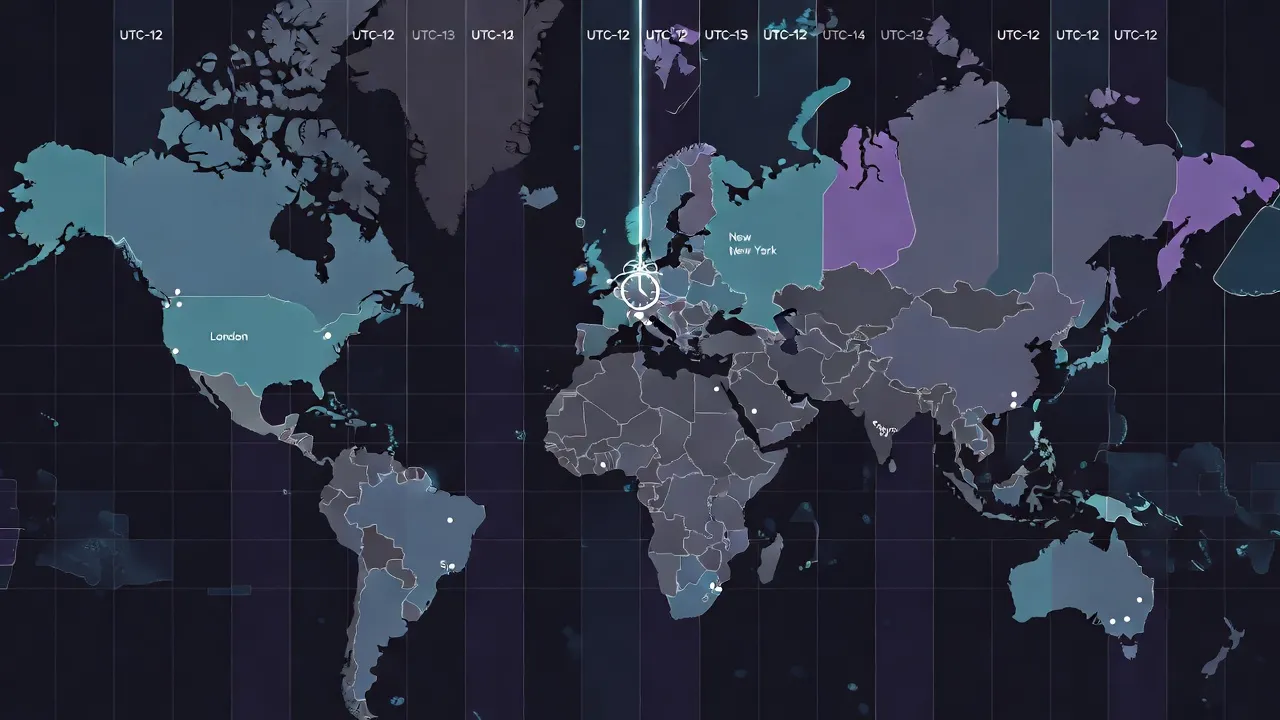
For everyday purposes, UTC and GMT are practically identical — both represent the time at 0° longitude, the Prime Meridian passing through Greenwich, London. However, there is a technical distinction:
- GMT (Greenwich Mean Time) is a time zone based on astronomical observations of the Sun's position
- UTC (Coordinated Universal Time) is a time standard maintained by a network of over 400 atomic clocks worldwide, accurate to within a billionth of a second
Because Earth's rotation is slightly irregular and gradually slowing, UTC occasionally adds a "leap second" to stay synchronized with solar time. The last leap second was added on December 31, 2016. For scheduling meetings or using our EDT to CST converter or London vs New York time difference, the difference between UTC and GMT is negligible.
How Time Zones Are Defined as UTC Offsets
| Time Zone | UTC Offset | Example City | Converter |
|---|---|---|---|
| HST | UTC−10 | Honolulu | — |
| PST/PDT | UTC−8/−7 | Los Angeles | PST↔AEST |
| MST | UTC−7 | Denver, Phoenix | EDT↔MST |
| CST/CDT | UTC−6/−5 | Chicago, Houston | EDT↔CST |
| EST/EDT | UTC−5/−4 | New York, Miami | PDT↔EDT |
| GMT/BST | UTC+0/+1 | London | London↔NY |
| CET/CEST | UTC+1/+2 | Paris, Berlin | CEST↔CST |
| IST | UTC+5:30 | Mumbai, Delhi | SGT↔IST |
| SGT | UTC+8 | Singapore | SGT↔PST |
| JST | UTC+9 | Tokyo | EST↔JST |
| AEST | UTC+10 | Sydney | Sydney↔NY |
Why "UTC" and Not "CUT" or "TUC"?
The abbreviation UTC is a deliberate compromise. English speakers proposed CUT (Coordinated Universal Time), while French speakers wanted TUC (Temps Universel Coordonné). The International Telecommunication Union settled on UTC — which does not perfectly match either language but serves as a universal, language-neutral abbreviation. This international spirit mirrors our approach with the time zone converter: supporting every major time zone regardless of region.
Who Uses UTC?
UTC is the backbone of modern timekeeping across virtually every industry:
- Aviation: All flight plans and air traffic control use UTC, called "Zulu time" (the Z suffix in timestamps like "1430Z")
- Computing: Unix timestamps, database records, and API responses default to UTC. JavaScript's
Date.getTime()returns milliseconds since January 1, 1970 UTC - Science: Research papers timestamp experiments in UTC to ensure global reproducibility
- Finance: International markets use UTC to synchronize trading across the Paris vs New York time difference and Sydney vs New York time difference
- Space exploration: NASA, ESA, and all space agencies coordinate missions in UTC
For everyday users, our time zone converter and specific time converter convert any time zone pair instantly, but understanding that UTC is the foundation of every conversion helps you appreciate why accuracy matters — especially during daylight saving time transitions.