
If you have ever scheduled a meeting and seen the time listed as "EST" in July, you have witnessed one of the most common time zone mistakes in the English-speaking world. Understanding the difference between EST (Eastern Standard Time) and EDT (Eastern Daylight Time) is essential for accurate scheduling, whether you are coordinating a business call with colleagues in New York, catching a live event, or converting time zones using our time zone converter.
What Is EST (Eastern Standard Time)?
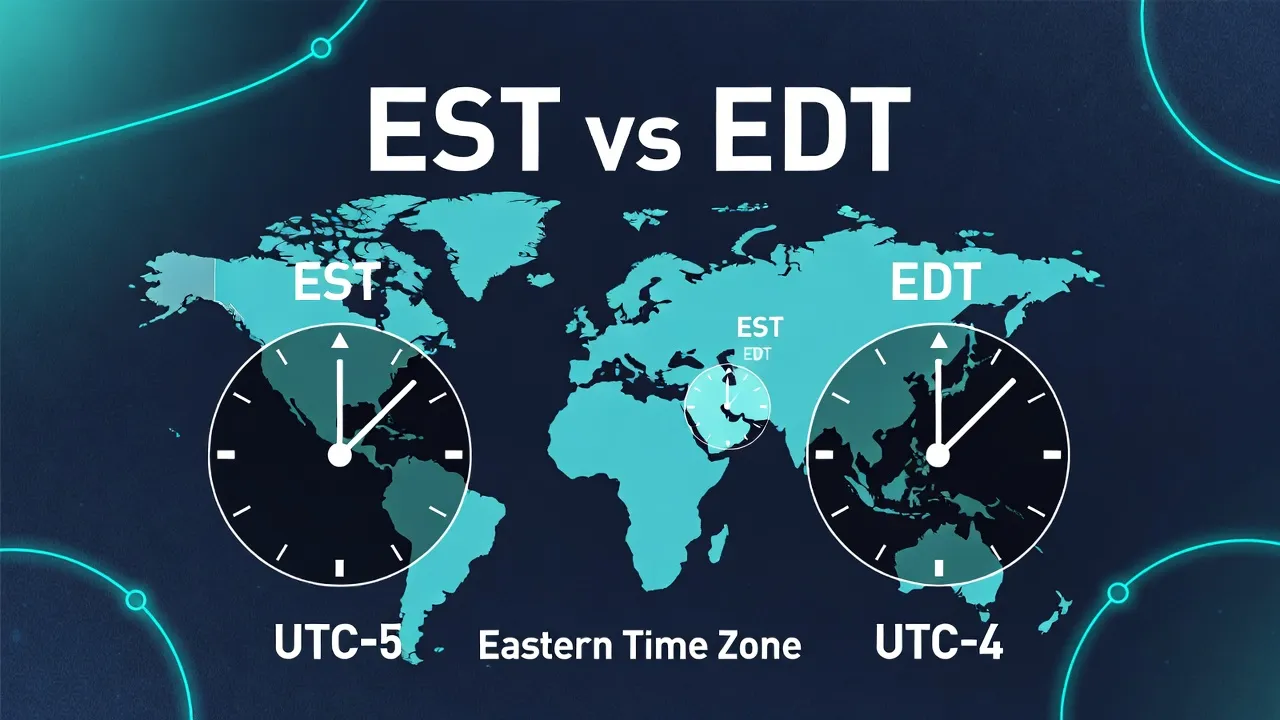
Eastern Standard Time (EST) is the time zone observed during the colder months in the eastern United States and Canada, from the first Sunday in November through the second Sunday in March. EST is UTC−5, meaning it is 5 hours behind Coordinated Universal Time. Major cities following EST include New York, Washington D.C., Miami, Atlanta, Boston, Philadelphia, and Toronto.
During EST, when it is 12:00 PM noon in New York, it is 5:00 PM in London (GMT), 6:00 PM in Paris (CET), and 2:00 AM the next day in Sydney (AEST). You can verify these conversions instantly with our EDT to CST converter or check the California vs New York time difference.
What Is EDT (Eastern Daylight Time)?
Eastern Daylight Time (EDT) takes effect when clocks "spring forward" one hour on the second Sunday in March. It lasts until the first Sunday in November. EDT is UTC−4 — one hour ahead of EST. This shift gives people an extra hour of evening daylight, which is why the practice is called "daylight saving time" (not "daylight savings time," though the latter is commonly used).
During EDT, the same noon time in New York corresponds to 4:00 PM in London (if UK is on BST), showing how daylight saving transitions can temporarily change the gap between time zones. Use our time zone converter to always get the accurate current conversion.
EST vs EDT: Key Differences at a Glance
| Feature | EST | EDT |
|---|---|---|
| Full Name | Eastern Standard Time | Eastern Daylight Time |
| UTC Offset | UTC−5 | UTC−4 |
| Active Period | Nov → Mar | Mar → Nov |
| Daylight Saving | No (standard time) | Yes (DST active) |
| Clock Change | Fall back 1 hour | Spring forward 1 hour |
| Months Active | ~4.5 months | ~7.5 months |
Why Does the EST vs EDT Distinction Matter?
Confusing EST and EDT can cause you to be one hour early or late for meetings, flights, or live events. Consider this scenario: your client in London says "let's meet at 3 PM EST" during July. Technically, EST is not active in July — they should say EDT. If you convert using the wrong offset (UTC−5 instead of UTC−4), you will join the call an hour late.
This confusion is especially problematic for international scheduling. If you are converting between PDT to EDT converter or working with colleagues across the London vs New York time difference, even a one-hour error can cascade into missed deadlines and frustrated teams. Our specific time converter eliminates this guesswork entirely by automatically applying the correct offset.
Which US States Use Eastern Time?
The Eastern Time Zone covers 22 US states entirely or partially, plus Washington D.C., making it the most populated time zone in the United States. Approximately 47% of the US population lives in the Eastern Time Zone. Key states include New York, Florida, Georgia, North Carolina, Virginia, Pennsylvania, Ohio, Michigan, and Indiana (most counties).
Interestingly, Indiana is split: most of the state observes Eastern Time, but several counties near Chicago follow Central Time. This has been a source of confusion for decades and highlights why using a reliable time zone converter is so important when scheduling across state lines.
How to Handle EST/EDT in International Scheduling
The safest approach is to use "ET" (Eastern Time) as a catch-all abbreviation that automatically implies the correct offset for the current date. Most calendar applications like Google Calendar, Microsoft Outlook, and Apple Calendar handle the EST/EDT switch automatically when you select "Eastern Time (US & Canada)" as your time zone.
For quick conversions, bookmark our most popular tools: EDT to CST converter, PST to AEST converter, and EST to JST conversion. Each page includes a full 24-hour conversion table, live clocks, and DST information so you never have to wonder which offset to apply.
The 2026 EST/EDT Transition Dates
In 2026, the transitions are: Spring forward on Sunday, March 8 at 2:00 AM (EST → EDT), and Fall back on Sunday, November 1 at 2:00 AM (EDT → EST). Mark these dates — they affect every time zone conversion involving Eastern Time. During the transition weeks, double-check your conversions using our time difference calculator to verify the exact hour gap between cities.
Related Time Zone Conversions
If you frequently work with Eastern Time, these converter pages will be especially useful:
- EDT to CST converter — the most searched US time zone conversion
- EDT to MST converter — for Mountain Time coordination
- EST to JST conversion — connecting US East Coast to Japan
- 11 AM SGT to PST — for calls between US and Southeast Asia
- Paris vs New York time difference — European business scheduling