
Ask most people how many time zones exist, and they will confidently say 24 — one for each hour of the day. In reality, the world has 38 distinct time zones, spanning from UTC−12 to UTC+14. The extras exist because many countries adopt half-hour or quarter-hour offsets that do not align with the neat 24-slice model. Our time zone converter supports all major zones, making conversions between any pair instant and accurate.
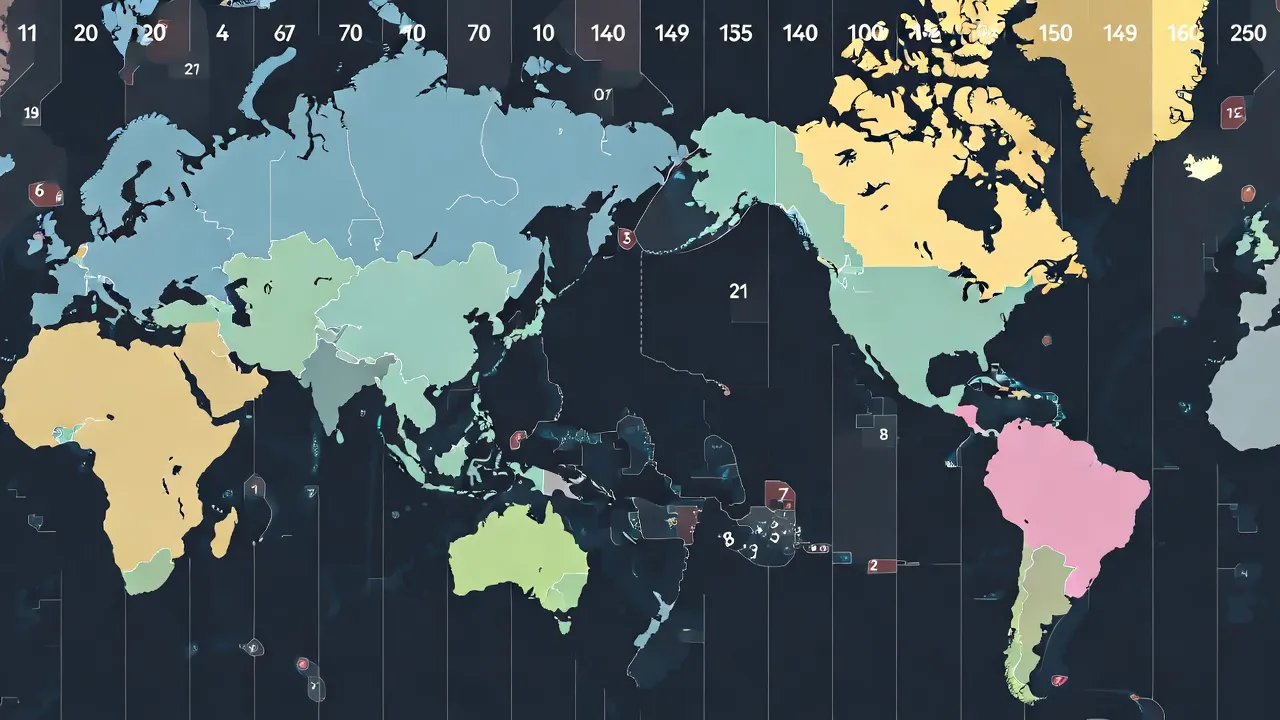
Why More Than 24 Time Zones?
When Sir Sandford Fleming proposed the global time zone system in 1879, he envisioned 24 equal slices of 15° longitude each. But political boundaries, economic ties, and geographic practicality led many regions to adopt non-standard offsets:
- India (IST, UTC+5:30) — a single 30-minute offset time zone for 1.4 billion people. Use our SGT to IST converter to convert
- Nepal (UTC+5:45) — the only country using a 45-minute offset
- Chatham Islands (UTC+12:45) — a New Zealand territory 45 minutes ahead of mainland NZ
- Iran (UTC+3:30) — a half-hour offset from neighboring Gulf states (UTC+4)
- Myanmar (UTC+6:30) — between India's UTC+5:30 and Thailand's UTC+7
- Marquesas Islands (UTC−9:30) — French Polynesia's unique offset
Countries with Multiple Time Zones
| Country | Time Zones | Span |
|---|---|---|
| France (incl. overseas) | 12 | UTC−10 to UTC+12 |
| Russia | 11 | UTC+2 to UTC+12 |
| United States | 6 | UTC−10 to UTC−5 |
| Canada | 6 | UTC−8 to UTC−3:30 |
| Australia | 5 | UTC+8 to UTC+11 |
| Brazil | 4 | UTC−5 to UTC−2 |
The California vs New York time difference spans 3 of America's 6 time zones. For international comparisons, check our time difference calculator to see how cities like Sydney vs New York time difference compare across vast distances.
China: One Time Zone for 9.6 Million km²
Despite spanning five geographic time zones, China uses a single time zone — UTC+8, known as Beijing Time or China Standard Time (CST, not to be confused with US Central Standard Time). This means that in Kashgar, in China's far west, the sun does not rise until nearly 10:00 AM local time in winter, and sunset can be as late as midnight in summer.
Unofficially, the Xinjiang Uyghur Autonomous Region uses "Xinjiang Time" (UTC+6) for daily activities, creating a two-hour split with the rest of the country. This quirk makes China one of the most interesting case studies in time zone politics.
The International Date Line
The International Date Line (IDL) runs roughly along the 180° meridian in the Pacific Ocean. Crossing it eastward (e.g., from Japan to Hawaii) moves you back one calendar day; crossing westward moves you forward one day. The IDL is not straight — it zigzags dramatically to avoid splitting countries and island groups across two dates.
Kiribati made headlines in 1995 when it shifted the IDL eastward so all of its islands could share the same date. This created UTC+14 — the world's furthest-ahead time zone — making Kiribati the first place to enter each new year.
Explore Time Zones with Our Tools
Whether you are converting between EDT to CST converter across the US, checking the PST to AEST converter for trans-Pacific scheduling, or comparing the Paris vs New York time difference for European business, our tools cover every major conversion instantly. Browse our full time zone converter for any pair, or check specific times like 10 AM PDT to EDT and 9 AM PDT to CST for pre-calculated answers.